 Top Trending
Four Plants From a Farm in the Blue Ridge Mountains, in Two Liquid-Filled Capsules, Twenty Servings to the Bottle. I Weighed Each Plant Against Its Best Trial Before I Answered the Neighbor Who Asked.
Nootropic Focus is a capsule from Gaia Herbs, a company that grows on its own farm in western North Carolina: saffron, ginkgo, spearmint and lemon balm as liquid extracts inside a vegan capsule, two capsules once or twice a day between meals. A neighbor with a garden asked me whether it was worth the money, so I read the label, the four plants' trials at the doses they actually used, all 48 reviews and the return page before I answered him, and this page is the answer.

This is a paid advertisement. Sponsored by Gaia Herbs, Inc.
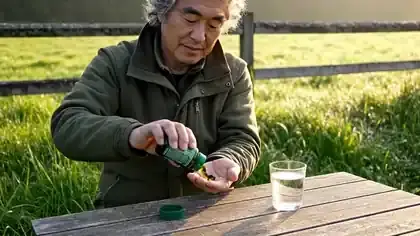
Owen Marsh is the pen name of this desk.
The customers quoted on this page are real; their reviews are public on the seller's site and were read through the seller's own review system on September 9, 2026.
I haven't met them and know nothing about them beyond what they wrote.
The small photos beside their reviews are illustrations, not the reviewers.
Everything about the bottle, from the milligrams on the panel to the 45 days, comes from the seller's own label and pages, read the same day.
My neighbor grows spearmint by his back step and can't keep it from taking over the bed.
So when he showed me a bottle with spearmint on the label, and saffron, and ginkgo, and lemon balm, he had a fair question.
"I've got two of those in the yard," he said.
"Is the bottle any better than the yard?"
I told him I'd read it and get back to him.
Here's what I read.
The bottle holds 40 capsules, and a serving is two.
Twenty servings.
Ten days if you take the label's higher dose, twenty if you take the lower.
Inside two capsules: 32 milligrams of saffron extract, 120 milligrams of ginkgo leaf extract, and 800 milligrams of a blend of spearmint and lemon balm that the label doesn't split.
Two liquid-filled capsules, four plants, twenty servings. Every number on this page is for those two capsules, and the first thing to know about them is how fast the bottle goes.
Now the second number, because it's the one that matters most and it's the one that flatters the bottle least.
The one plant here with a trial in people your age at exactly this dose is ginkgo, 120 milligrams, and its bigger trial, six years long, found nothing at twice that. [1]
I'll get there.
Here's what the bottle is.
A small green bottle of 40 dark, liquid-filled vegan capsules from Gaia Herbs, a company that has grown herbs on its own farm near Brevard, North Carolina, for decades.
The seller calls them Liquid Phyto-Caps: the plant extracts, in glycerin and water, sealed inside a capsule of plant fiber, so you swallow a liquid without tasting it.
Five calories.
No corn, dairy, gluten, peanuts, shellfish, soy, sugar, tree nuts or yeast, the label says.
I did what I always do.
I read the label before the listing.
I read the trials behind each of the four plants, at the doses they actually used, and I'll tell you where I found none.
I read all 48 reviews, kept five, and I'll tell you why one of them has one star.
And I read the return page, which is kinder than most.
What I found is a clean, well-made capsule from honest farmers, with one plant at a real trial dose that mostly failed its trials, one with no trial I could read, and two kitchen herbs at an amount the label won't split.
One more thing before the first field, because most of you got here from one of our own advertisements.
Those ads talk about a boxed cereal, three foods, three drinks, and three words or phrases a man is supposed to be able to say or spell.
None of that is in the bottle, and I won't pretend it is.
It's on this page, in its place: the cereal, the drinks and the word test are the eighth field, and the honest version of every headline we run is in the guide linked at the foot.
Field one · The bottleForty Capsules, Four Plants, and a Farm in the Mountains
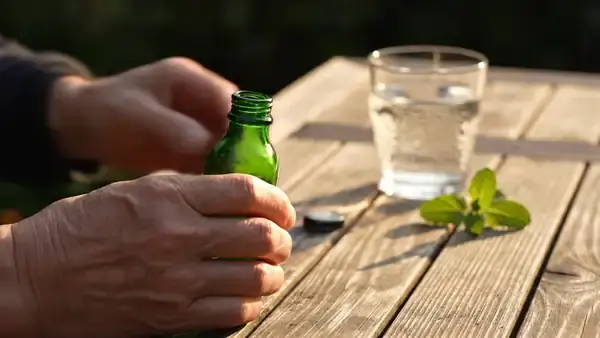
This is what's on the garden table.
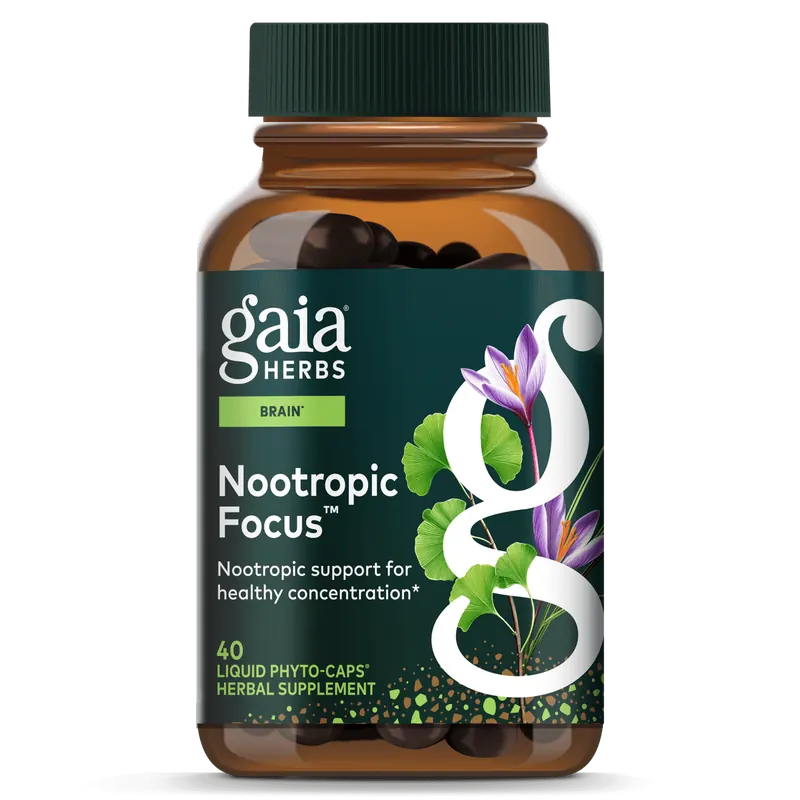
A squat green bottle with a white label and the seller's leaf on it.
The front says Nootropic Focus, then "supports memory function and clear concentration," with the little asterisk that points to the sentence every supplement in America carries.
Forty Liquid Phyto-Caps, it says at the bottom.
The back is where the numbers are, and there are only three.
"Serving size 2 capsules.
Servings per container 20."
Saffron stigma extract, 32 milligrams.
Ginkgo leaf extract, 120 milligrams.
Herbal extract blend, 800 milligrams: organic spearmint leaf and organic lemon balm aerial parts, in that order, with no figure for either.
Then glycerin, water and the capsule, which is plant fiber colored with chlorophyll.
The directions are two lines, and I'll quote them exactly.
"Adults take 2 capsules 1-2 times daily between meals.
Take as needed, suitable for long-term use."
And the cautions, which I'll paraphrase rather than quote: not for use in pregnancy or nursing; and if you have a medical condition, especially one that affects how your blood clots, or you take anything daily, ask your health-care practitioner before use.
Hold onto that line about clotting. It's there because of the ginkgo, and it comes back in field three.
One more thing off the label.
The seller prints its address in Brevard, North Carolina, on the panel, and its customer service in Mills River, a few miles away, on its website.
Both are real places in the mountains, and the farm is between them.
That matters more than it sounds, and I'll say why at the end.
Field two · The arithmeticTwenty Servings, Ten Days, and What the Label Won't Split
Let me show you the arithmetic, because the arithmetic is the product.
Forty capsules, two to a serving, so twenty servings.
The label says one to two servings a day.
At one, the bottle lasts twenty days.
At two, ten.
At the seller's list price, that's a little under two dollars a day at the low dose and nearly four at the high one.
I mention it once, here, and not again until the end.
Now the 800 milligrams.
It's the biggest number on the label, and it's two plants with no line between them.
On a label, the bigger share comes first, so spearmint is probably most of it and lemon balm the rest.
But "probably most of 800" is not a number I can put beside a trial, and I'll show you why that matters in field four.
Three numbers on the panel: 32, 120 and 800.
The first has no trial in healthy adults I could find.
The second matches a trial that came out small, and a bigger one that came out empty.
The third is two plants sharing one figure.
Every plant in this bottle has been studied. Only one of them has been studied at the amount that's in two capsules, and that's the one whose biggest trial found nothing.
Field three · GinkgoOne Hundred Twenty Milligrams, the Twelve-Week Trial and the Six-Year Trial
Second on the label, and the plant everyone has heard of.
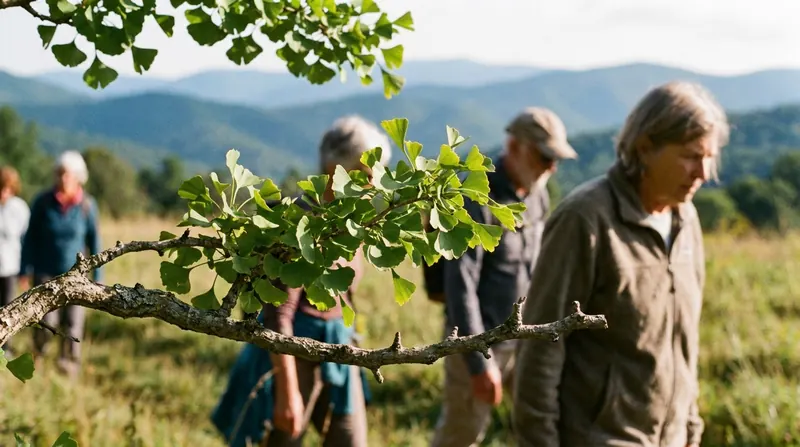
Ginkgo is the fan-leaved tree from China that lines half the streets in America, and the leaf extract is the most-tested herb on this page.
The bottle holds 120 milligrams per two capsules, and for once the number lines up with a trial in people your age.
Ninety-three healthy adults aged 55 to 79 took 120 milligrams a day of a standardized extract, or a placebo, for twelve weeks.
On one memory test, learning pairs of words, the ginkgo group did moderately better.
On every other measure, attention, executive function, how people felt, nothing. [2]

That's the kind trial.
Now the big one.
Three thousand and sixty-nine adults aged 72 to 96 took 120 milligrams twice a day, or a placebo, for a median of six years.
They declined at the same rate, in memory and in everything else measured. [1]
The National Institutes of Health says there's no conclusive evidence ginkgo helps with any health condition. [3]
One hundred twenty milligrams a day for twelve weeks moved one test, a little.
Two hundred forty a day for six years moved nothing.
The bottle holds 120 per two capsules, and the label doesn't say how it's standardized.
And the caution, which the label puts in its own words: ask first if your blood clots slowly or you take anything daily.
Ginkgo can add to the effect of anything that thins the blood.
If you take something like that, or you have a procedure coming, that's a question for your clinician before the first capsule.
Field four · SaffronThirty-Two Milligrams of the Most Expensive Spice, and the Trial I Couldn't Find
First on the label, and the plant that makes the bottle look expensive.
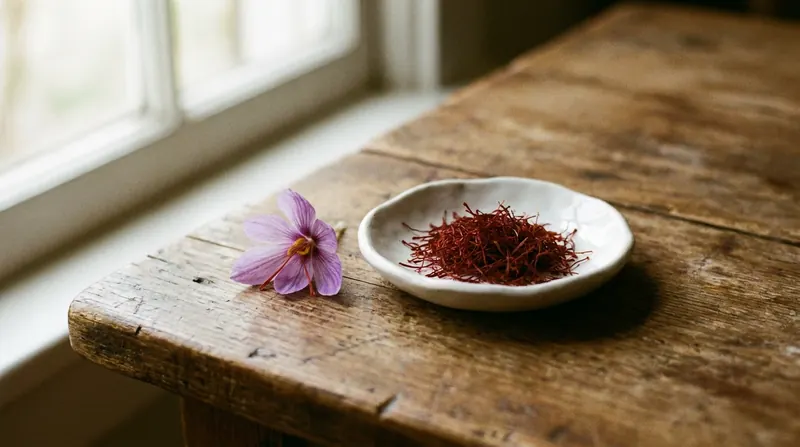
Saffron is the dried red stigma of a crocus, picked by hand, about 150 flowers to the gram.
It colors paella and rice yellow, and the bottle holds 32 milligrams of an extract of it per two capsules.
I went looking for a randomized trial of saffron on memory or attention in healthy adults, or healthy older adults, and I couldn't find one I could read.
The trials I found were in people with a named condition, which is not the terrain of this page, and I won't borrow from them.
Thirty-two milligrams of saffron extract, and no trial in a healthy man of 65 that I could put beside it. That's a blank where a number should be, and I'd rather show you the blank.
Saffron is the plant this bottle is priced on, and it's the plant with the least I can say.
That isn't a verdict against it.
It's an absence.

Field five · Spearmint and lemon balmEight Hundred Milligrams Between Two Kitchen Herbs, and the Trial That Used 900 of One
Third and fourth on the label, and my neighbor's two plants.
Spearmint is the mint of chewing gum and mint sauce, and the one that takes over his bed every June.
Lemon balm is its lemon-scented cousin, the leaf people put in tea to settle down.
Together they make the 800-milligram blend, and the label doesn't say how much is which.
Spearmint has a real trial, and it's the reason I read this bottle carefully.
Ninety adults with the ordinary memory slips of age, average age 59, took 900 milligrams a day of a spearmint extract rich in a compound called rosmarinic acid, or a placebo, for 90 days.
At 900 milligrams, the quality of their working memory improved by 15 percent versus placebo, and their spatial working memory by 9.
At 600 milligrams, the paper doesn't report a difference. [4]
In 142 healthy young adults, the same 900 milligrams was tied to better sustained attention at days 30 and 90. [5]
Now hold the bottle up to that.
The trial used 900 milligrams of a standardized spearmint extract alone, and 600 didn't clear the bar.
The bottle holds 800 milligrams of spearmint and lemon balm together, unstandardized, unsplit.
Nine hundred milligrams of one standardized spearmint extract worked.
Six hundred didn't.
The bottle holds "most of 800" of a different spearmint preparation, and the label won't say how much.
Lemon balm has a smaller story.
Twenty healthy young adults took single doses of a standardized extract.
At 600 milligrams their accuracy of attention improved, but at some doses and times their memory scores went down, and at 900 milligrams they rated themselves less alert. [6]
Twenty people, young, one afternoon each, with results pointing both ways.
If the bottle printed "spearmint 900 milligrams, standardized," I'd be writing a different page. It prints 800 of two herbs together, and my neighbor's back step holds more of one of them than he can use.
Field six · The likelier explanationWhy a Man Feels Sharper Mid-Morning, and Which Part Is the Capsule
Suppose you buy it, take two between breakfast and lunch tomorrow, and feel a little clearer by eleven.
I'd believe you.
And I'd give you three reasons before I gave the plants one.
You drank a glass of water at an hour you'd normally have poured coffee.
You did one deliberate thing mid-morning, and you're watching for it to work.
And you paid for it, which is the strongest ingredient in any bottle.
There's no caffeine in this one. Whatever you feel by eleven, it isn't that.
What actually helps, and costs nothing, is duller than four plants.
- Water mid-morning and mid-afternoon, at the hours you'd have poured a third and fourth coffee.
- No coffee after two. The three o'clock cup answers three o'clock and wrecks eleven.
- Ten minutes in the garden before the hard part of the day. Under a tree, if there's one.
- One thing at a time. Radio off while you read the seed packet.
- A notebook. Writing a thing down is the oldest memory aid there is, and it never runs out.
Now look at that list and be honest.
You've heard every item since your first physical, and you still don't do them.
Boring loses to a green bottle every time.
If a capsule gets you to drink two glasses of water and take two pauses a day, it did its work before any plant did. And the plants, at these amounts, aren't going to do much.
Field seven · The reviewsForty-Eight Reviews, Twelve Verified, and Five Kept, One of Them With One Star
The seller's page shows 48 reviews with an average of 4.4 stars.
Its review system marks 12 of them as confirmed purchases.
I read every one.
Then I threw out most of them, and I'll tell you which.
I threw out the ones about energy, outlook and dreams, because the label doesn't claim any of that.
I threw out one that mixed the capsule with a list of other products, because I've promised not to sell against other formats on this page.
I threw out the ones written before the bottle arrived, the ones about the company rather than the bottle, and one about somebody else's focus.
And I kept a one-star review on purpose, because a man who paid for the bottle and got nothing deserves the same space as one who paid for it and loved it.
These are real customers, quoted word for word from the seller's review system; the small photos beside them are illustrations, not the reviewers.

Makes my mind clearer. I love Gaia's Herbs. I find I absorb them better. Easy to take and clean.

Love this product. I can definitely tell when I forgot to take it.

Love it so far. Have to reorder.

Less than satisfied with this product. I have been using this product going on 2 weeks now and have not noticed any improvement in my overall focus.

I have used these herbs for some years in tisanes either singly or in combination but these capsules with this optimum combination are much more convenient. The capsules are medium size and slip down easily. No aftertaste.
Read those the way I did.
Robyn says "clearer" and "easy to take."
Carol says she notices when she forgets it.
Matt says "so far."
Those are the kind of things people say about a habit that fits.
Ife gave it one star after two weeks and said so plainly.
Two weeks is exactly how long a bottle lasts at the low dose, and he's the only one who told me what nothing looks like.
And the last one, who isn't a confirmed buyer, has been drinking these plants as tea for years and likes the capsule for its convenience.
That's the most useful sentence in the pile: the plants are the same ones in the yard; the capsule is the convenience.
Nobody I kept claims their memory came back.
Two describe feeling clearer; one describes nothing at all.
Between them is the truth, and it's closer to the middle than the label.
Field eight · The bowl and the cupThe Cereal, the Three Drinks, the Three Foods and the Word Test From Our Own Advertisements
Our advertisements have been saying, in one version or another, that a boxed cereal, three foods and three drinks have something to do with memory, and that there are three words or phrases a man ought to be able to say.
You're owed the honest version, in one field, so here it is.
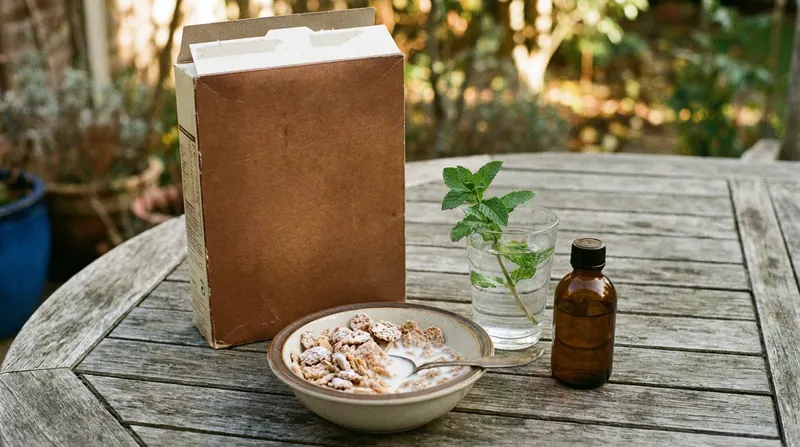
Start with the bowl.
A frosted, honey-coated or chocolate cereal is mostly refined starch and added sugar, and a serving can carry more sugar than a cookie.
No cereal "ages the brain faster than time."
Nobody has measured any such thing, and that phrase was written to be clicked.
What the studies do say is duller, and worth more.
In the Framingham Heart Study, adults who drank more sugary beverages scored lower on tests of memory, and daily fruit juice went the same way. [7]
In a Brazilian study of 10,775 adults followed for eight years, the ones who ate the most ultra-processed food, and the sweet cereal shelf is part of that, lost ground on tests of thinking about a quarter faster than the ones who ate the least. [8]
Both are associations across a population, not a sentence on your bowl.
And a quarter faster than slow is still slow.
The three drinks.
The "evening drink" in our advertisement is alcohol, and it's the one with the strongest case behind it: in 550 British civil servants followed for thirty years, the more a person drank, the faster their scores fell on a word-fluency test, and light drinkers had no edge over those who didn't drink at all. [9]
The second is sugar in a glass: soda, sweetened tea, the tall flavored coffee from the counter, which is a soft drink with coffee in it.
The Framingham finding above is about sugary drinks, and those are sugary drinks. [7]
The third, in one of our headlines, was coffee.
That was our worst headline.
Plain black coffee and plain tea aren't the drinks any of those studies were about.
Keep your coffee.
Keep it before two.
And a glass of water with a sprig of mint from the yard is the drink this bottle was always going to lose to.
The three foods.
Processed meat, fried food, and the white-flour shelf: pastries, packaged cakes, white bread.
Our advertisement says "just stop eating these three."
The research says something slower.
In 960 older adults followed for nearly five years, the ones whose meals looked most like the MIND pattern, vegetables, berries, nuts, whole grains, beans, fish and olive oil, held their thinking scores better, and the gap between the top and bottom thirds worked out to about seven and a half years of age. [10]
That's a pattern over years, not a list of three, and it can't be sold in a headline.
Which is exactly why our headline doesn't say it.
Less sugar in the bowl and the glass.
Less alcohol in the evening.
Keep the coffee.
Eat more like the Mediterranean shelf and less like the vending machine.
Every one of those costs nothing, and none of them is in the bottle.
The three words, or the three phrases.
There's no such list.
What our advertisement borrowed from is the short, scored mental-status test clinicians have given at the bedside since the 1970s: the date and the place, a few words to hold in mind and give back a minute later, a sum, naming, repeating one sentence, copying a drawing.
It's given in person and read against your age and your schooling by someone trained to do it, and a low score is a reason for a proper look, not a verdict.
Stumbling on a word when you're tired or being timed means nothing on its own.
Nothing begins at a word.
If the worry behind the click is real, that's fifteen minutes with your own clinician, and it costs you nothing from me.
And the advertisement about the things some men take every day.
That one sits closest to real research, and it's the one an advertisement has no business acting on.
Some kinds of daily medicine, including a few sold over the counter for allergies and for the night, are on the lists pharmacists check for people over 65.
Don't stop or change any of it because of an advertisement, ours included. Put everything you take in one bag, this bottle included, take it to the pharmacist, and ask one question: is anything here a poor choice at my age?
Ginkgo belongs in that bag; the label says so.
The guide at the foot of this page has that section written out, with the studies.
So if you clicked on the cereal, here's where the cereal went: onto the garden table next to a glass of water with mint in it, where the real answer was always the plainer bowl and the walk to the fence.
Field nine · What it isn'tSix Things Two Capsules Won't Do
- It won't give you the spearmint trial dose. The trial used 900 milligrams of one standardized extract, and 600 didn't clear the bar; the bottle holds 800 of two herbs together, unsplit.
- It won't give you a saffron trial to lean on. I couldn't find one in healthy adults, and I won't borrow from the others.
- It won't beat ginkgo's own record. The twelve-week trial at this dose moved one test a little; the six-year trial at twice the dose moved nothing.
- It won't act on any condition a clinician has named. It's a dietary supplement, and its own label carries the sentence that says so.
- It won't be for anyone whose blood clots slowly, who takes a blood thinner, or who has a procedure coming, without a clinician's say-so. The label says ask.
- It won't last the month. Twenty servings: ten days at the label's high dose, twenty at the low one.
If that list annoys you, I'd rather you were annoyed now than when the box arrives from the mountains.
Field ten · The routineIf You Do Buy It: One Bottle, Twenty Days, Two Glasses of Water, One Notebook
If you're going to spend the money, spend it as a test with a date on it, and test the thing that can actually work.
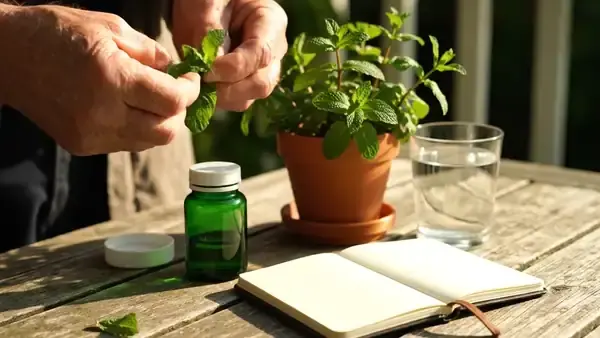
- Buy one bottle, and take the label's low dose: two capsules once a day, between meals. Twenty days is the test, and it fits inside the 45-day promise with time to decide.
- A full glass of water with the capsules at ten, and another at three. The capsule is the excuse; the water is the point.
- Nothing with caffeine after two, the same as before. The bottle has none; make the afternoon match it.
- Write one line a day in a notebook. Not "sharper" or "foggier." What you were doing at eleven, and how it went.
- Keep the coffee where it is for the first ten days, so you know what the capsule does. Cut the afternoon cup in the second ten, so you know what the water does.
- On day twenty, read the twenty lines. If the second half reads better than the first, decide which of the two changes did it. The notebook will tell you more than the bottle will.
Look at that list the way I do.
Four of the six things cost nothing.
The bottle is the one you'll pay for, and the water and the notebook are the ones that will do the work.
Field eleven · Who it's forWho It Suits, and Who It Doesn't
This is worth a look if:
- You like plants with names, grown by people you can find on a map, and you've now seen exactly how much of each is in two capsules.
- You want a company with a farm, a street address, a phone number that answers, and a 45-day promise that says the word refund. You have all four now.
- You can hold two ideas at once: four real plants with real trials, at amounts the trials didn't use.
- You'll run it as a twenty-day test with a notebook, not as a hope.
- You don't take anything that thins the blood, or you've asked.
Give it a miss if:
- You want the spearmint trial dose, or a saffron trial to lean on. Buy the standardized extract, or wait for the trial.
- Your blood clots slowly, you take a blood thinner, or you have a procedure coming. The label says ask first. Ask.
- You want something that acts on a condition a clinician has named. This is a dietary supplement.
- You're pregnant or nursing. The label rules you out.
- You want a bottle that lasts a month. This one lasts ten to twenty days.
Field twelve · Where it's soldFrom the Mountains of North Carolina, With Shipping at no charge Above a Line and 45 Days to Decide
The bottle is sold by Gaia Herbs on its own website, and that's the only place this page links to.

The company is easy to find.
Gaia Herbs, Inc., with its farm and its label address near Brevard, North Carolina, and its customer service office a few miles away in Mills River, both printed where you can read them.
A toll-at no charge number that answers, an email on the contact page, and decades of growing herbs on the same ground.
That's why I told my neighbor the bottle was honest even before I told him what was in it: you can drive to the field.

The current price is shown on its page, not here.
The day I read it, a bottle cost less than the seller's at no charge-shipping line, so expect a shipping charge on a single bottle.
Buy one anyway.
Twenty days is a test.
Two bottles of something you haven't tried is a bet.
Now the two things that matter more than the price.
First, shipping.
Gaia ships within the United States from North Carolina, at no charge above the seller's order minimum, with the rate for smaller orders shown at checkout.
Second, the return policy.
Read this twice.
The seller's promise is short: if you're not in love with it, they'll refund you.
You have 45 days from the ship date, and you start the return by calling the toll-at no charge number or emailing the address on the contact page.
It's a real refund, with a real date on it, and it's longer than the bottle lasts twice over.
I'd rather say so than make you hunt for it.
Everything in two capsules
| Ingredient | Amount per serving |
|---|---|
| Saffron (Crocus sativus) stigma extract | 32 mg |
| Ginkgo (Ginkgo biloba) leaf extract | 120 mg |
| Organic spearmint (Mentha spicata) leaf | part of an 800 mg herbal extract blend |
| Organic lemon balm (Melissa officinalis) aerial parts | part of an 800 mg herbal extract blend |
| Other ingredients: vegetable glycerin, water, vegan capsule (hypromellose, chlorophyll) | — |
Full details on each ingredient are in the guide linked at the bottom of this page.
The ingredient and advertising guide linked at the foot of this page goes through every line of the label.
What each plant is.
What the research does and doesn't show, at what dose.
What to be careful about, ginkgo first.
And which of our own headlines it does and doesn't support.
Print it and take it to the pharmacist if you take anything daily.
It's written for that.
See the current price on the seller's site
Two liquid-filled capsules of saffron, ginkgo, spearmint and lemon balm, made on a North Carolina herb farm, taken between meals.
CHECK AVAILABILITYSold and shipped from North Carolina by Gaia Herbs, Inc. · Shipping at no charge only above the seller's order minimum; a single bottle is below it · Full refund within 45 days of the ship date, by phone or email
QuestionsWhat Readers Ask Me Before Their First Bottle
Questions readers ask
Is this medicine?
No. It's a dietary supplement, four plant extracts in glycerin and water inside a vegan capsule, made on a farm in North Carolina.
The label carries the standard sentence every American supplement carries, the one that says the FDA hasn't evaluated its claims, and the little asterisk on the front points to it.
How much spearmint is in it?
The label doesn't say. It prints 800 milligrams for spearmint and lemon balm together, spearmint first, and no split.
The spearmint trial used 900 milligrams of one standardized extract, and 600 didn't clear the bar.
Does it have caffeine?
No. None of the four plants carries any, and the label lists none.
Whatever you feel, it isn't that.
Can I take it with a blood thinner?
Ask your clinician first. The label itself says to ask if your blood clots slowly or you take anything daily, and that's because of the ginkgo.
How long does a bottle last?
Twenty servings of two capsules. Ten days at the label's higher dose, twenty at the lower.
The 45-day promise runs from the ship date, so it outlasts the bottle either way.
Will it help my memory?
I can't tell you that, and you should be wary of any page that does. Ginkgo at this dose moved one test in a twelve-week trial and nothing in a six-year one.
Saffron has no trial in healthy adults I could find. Spearmint's trial used more of a different preparation.
What the customers I kept describe is feeling clearer, and one of them describes nothing at all.
Can I take it alongside what I already take?
Ask your clinician or pharmacist and take the ingredient guide with you. Ginkgo and blood thinners are the main question; lemon balm may add to anything that makes you drowsy.
Two minutes at the pharmacy counter answers both.
Which reviews did you leave out, and why?
Forty-three of 48. The ones about energy, outlook or dreams, which the label doesn't claim; one that mixed it with a list of other products; the ones written before the bottle arrived; the ones about the company rather than the capsule; and one about somebody else.
What's left is quoted word for word, including the one-star review.
Does it ship to me?
Within the United States, from North Carolina. At no charge above the seller's order minimum; a single bottle is below it, so expect a shipping charge.
What if it arrives and I don't like it?
Call or email the seller within 45 days of the ship date and ask for a refund. That's the policy in its own words.
Your advertisement was about a cereal, or three foods, or three drinks. Where is that on this page?
In field eight, in full, with the studies. The short version: less sugar in the bowl and the glass, less alcohol in the evening, keep your plain coffee, and eat more like the Mediterranean shelf.
None of it is in the bottle, and the ingredient and advertising guide at the foot goes through every headline we run and says which ones overstate.
Your advertisement said something about three phrases, or spelling three words. Is there a test I can take?
Not on a screen. The words and phrases come from the short mental-status test clinicians give in person, and it's read against your age and schooling by someone trained to do it.
Nothing begins at a word. If the worry behind the click is real, ask your clinician for the proper test.
It's fifteen minutes.
The short versionEverything Above, in Sixty Seconds
- A green bottle of 40 liquid-filled vegan capsules from Gaia Herbs, Inc., of the North Carolina mountains: saffron, ginkgo, spearmint and lemon balm in glycerin and water.
- Two capsules once or twice a day between meals. Twenty servings: ten to twenty days.
- Ginkgo at 120 milligrams: one test moved a little in twelve weeks, [2] nothing moved in six years at twice the dose. [1] Saffron at 32 milligrams: no trial in healthy adults I could find. Spearmint and lemon balm at 800 milligrams together, unsplit: the spearmint trial used 900 of one standardized extract and 600 didn't clear the bar. [4]
- No caffeine. The label says ask first if your blood clots slowly or you take anything daily.
- Forty-eight reviews, average 4.4, twelve verified; the five I kept say "clearer," "I can tell when I forget it," and "have not noticed any improvement."
- Ships from North Carolina; at no charge above the seller's line; a full refund within 45 days of the ship date.
- The cereal, three drinks, three foods and the word test from our own advertisements, in field eight: less sugar, less alcohol, keep the coffee, more like the Mediterranean shelf, and no test on a screen. None of it is in the bottle.
- The honest use: two glasses of water and two pauses a day, with four named plants attached. One bottle, a notebook, twenty days.
The last fieldWhat Two Capsules Are Actually Worth
Here's the whole thing in one breath.
Four real plants, grown by real farmers in a valley you can drive to, sealed as liquid into a clean capsule.
One at a trial dose that mostly failed its trials.
One with no trial to lean on.
Two kitchen herbs sharing one number.
Twenty servings, and a refund window twice as long as the bottle.
And 48 customers, the best of whom say "clearer" and the most honest of whom says "nothing."
So here's what I told my neighbor.
The bottle isn't better than the yard.
It's more convenient than the yard, and it comes with ginkgo and saffron the yard doesn't grow.
If he wants a mid-morning ritual with four named plants and two glasses of water attached, that's worth a twenty-day test.
Not because of what's in the capsule.
Because of what he'll do around it.
Buy one bottle, not two, take the low dose, put a notebook next to the glass, and write one line a day for twenty days. The notebook is a better judge than I am.
Check the current price and availability
Two liquid-filled capsules of saffron, ginkgo, spearmint and lemon balm, made on a North Carolina herb farm, taken between meals.
CHECK AVAILABILITYSold and shipped from North Carolina by Gaia Herbs, Inc. · Shipping at no charge only above the seller's order minimum; a single bottle is below it · Full refund within 45 days of the ship date, by phone or email
P.S. If you take one thing from this page, take the two numbers.
Nine hundred milligrams of one standardized spearmint extract in the trial that worked, and 600 that didn't.
Eight hundred milligrams of two herbs together, unsplit, in the capsule.
Everything else about this bottle follows from holding those two side by side.
P.P.S. If the mid-morning fog has been with you for a year, and it's there before the coffee too, talk to your own clinician before you buy anything.
Two capsules with a glass of water is a small habit.
It was never going to answer a question a clinician answers in fifteen minutes.
P.P.P.S. And if you do order it, keep the notebook, and plant the spearmint.
When the bottle is empty, you'll have twenty lines about your own mornings and a bed you can't kill, and both are worth more than the bottle.